
News
Adaptive-Mesh Optimizations for Scale-Resolving Simulations using Dynamic Closures

14.10.2024 I Prof. Krzysztof Fidkowski from University of Michigan–Ann Arbor presents a data-driven approach for computing adjoint-based sensitivities in scale-resolving turbulent simulations. Scale-resolving simulations such as direct numerical simulations (DNS) and large-eddy simulations (LES) are much more computationally expensive than steady models, such as Reynolds-averaged Navier-Stokes (RANS). Each scale-resolving evaluation of a quantity of interest, often a statistical time-average, requires orders of magnitude more computational time and resources than in steady-state. This cost limits the applicability of unsteady simulations to many-query studies, such as shape optimization and mesh adaptation for numerical error control. Furthermore, unsteady adjoints, already an expensive proposition, cannot be directly applied to scale-resolving problems due to their chaotic nature. The sensitivity-calculation approach does not use unsteady adjoint equations but instead relies on unsteady data to train a corrected turbulence model, which then yields the required adjoint solutions. It is non-intrusive and inexpensive, requiring only a small number of unsteady forward simulations, but sufficiently powerful to capture unsteady effects in the sensitivities. Results for high-order discretizations of the unsteady Navier-Stokes equations, augmented by a corrected Spalart-Allmaras turbulence closure, demonstrate the ability of the approach in driving aerodynamic shape optimization in turbulent-flow conditions, and in adapting unsteady flowfields to target statistical outputs of interest.
Click here for the Sci-Fi-Turbo Seminar Adaptive Mesh Optimizations for Scale-Resolving Simulations using Dynamic Closures.
________________________________________________________________________________________________________________________________
Optimizing Chaos: Aerodynamic Design using High-Fidelity Scale Resolving Simulations
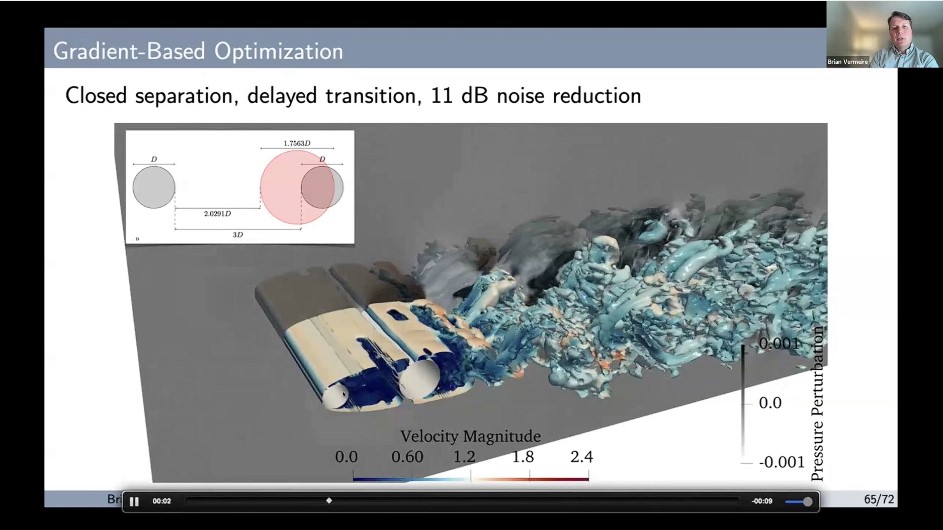
12.09.2024 I If you missed Prof. Brians Vermeires from Michigan University Sci-Fi-Turbo Seminar on Optimizing Chaos: Aerodynamic Design using High-Fidelity Scale Resolving Simulations, it it now online available!
Current industry-standard aerodynamic shape optimization is performed using a combination of Reynolds Averaged Navier-Stokes (RANS) solvers and adjoint-based optimization. However, despite decades of development RANS is often deficient, particularly for separated and transitional flows. High-fidelity scale-resolving techniques, such as Large Eddy Simulation (LES) and Direct Numerical Simulation (DNS), have been demonstrably more accurate in these flow regimes. Over the past decade enabling technologies for efficient high-fidelity simulations, including high-order spatial discretizations, temporal discretizations, and many-core hardware architectures, have significantly reduced their computational cost. However, significantly less attention has been dedicated to the development of suitable optimization frameworks for LES/DNS. This talk will focus on two recently proposed optimization frameworks for LES/DNS. The first is a gradient-based approach, which uses a combination of reduced order modelling, least squares shadowing, and the adjoint. The second is a gradient-free approach using Mesh Adaptive Direct Search (MADS). It will be demonstrated that both of these frameworks are suitable for the fundamental chaotic behavior of scale resolving simulations. The utility of these frameworks will then be demonstrated for general chaotic systems, aerodynamic optimization, and aeroacoustic optimization including low-pressure turbine cascades.
Click here for the Sci-Fi-Turbo Seminar Optimizing Chaos: Aerodynamic Design using High-Fidelity Scale Resolving Simulations.
________________________________________________________________________________________________________________________________
Sci-Fi-Turbo Live Seminar Serie

01.09.2024 I Join our monthly seminar series on the use of Scale-Resolved Simulation (SRS) for aerodynamic optimisation of aircraft engines. It brings together international experts in the field of SRS simulations and high-fidelity optimisation methods. We would like to invite all interested researchers, colleagues and interested participants to attend the presentations. The seminar series comprises invited lectures on a variety of topics related to the use of scale-resolving simulations (ILES, LES, DNS) for aerodynamic optimisation. It is part of the Horizon Europe project Sci-Fi-Turbo, which aims to revolutionise the design process of aircraft engines through the further development and integration of SRS simulations in optimisation procedures.
Our seminar programme will be updated regularly!
________________________________________________________________________________________________________________________________
Kick-off meeting at DLR site Cologne
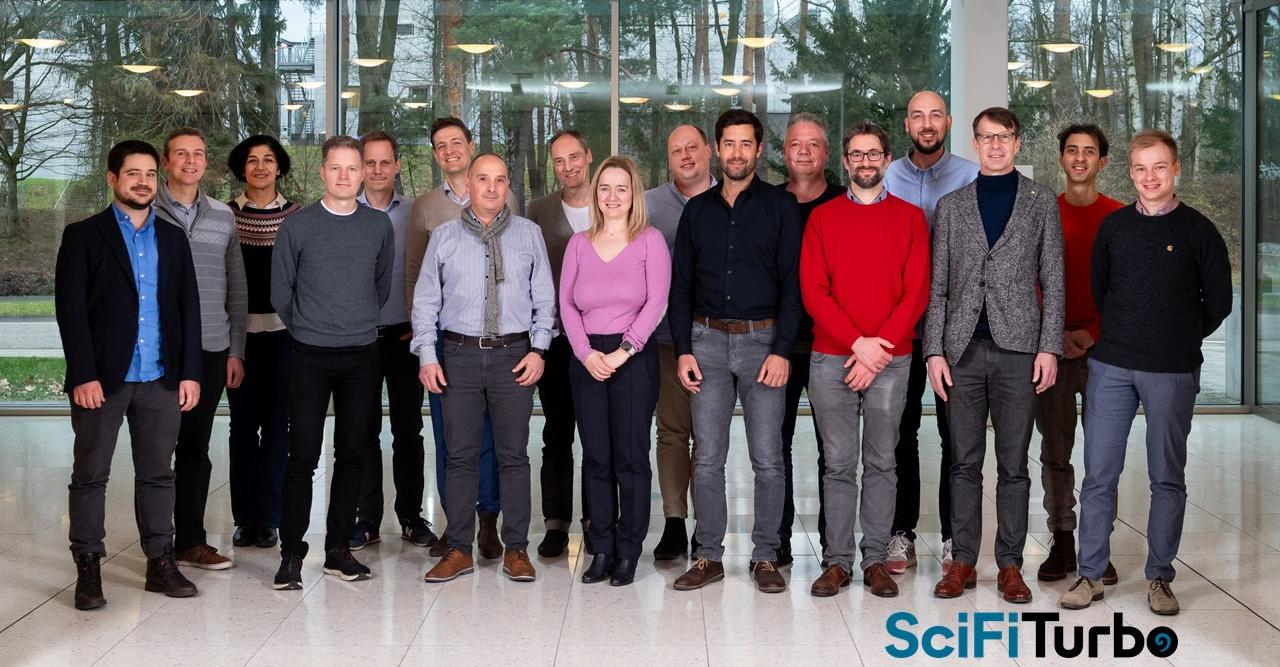
09.02.2024 I Under the leadership of the Institute of Propulsion Technology of the German Aerospace Center (DLR), the European Union-funded Sci-Fi-Turbo project (Scale-Resolution Simulations for Innovations in Turbomachinery Design) has been launched. The international research and industry partners from five EU countries, the UK and Australia met this week for a two-day kick-off meeting at the German Aerospace Centre in Cologne. The Sci-Fi-Turbo consortium brings together world-leading expertise in turbomachinery research and development. The consortium brings together expertise in computational science, numerical method development, all major research areas of computational fluid dynamics, high performance computing and turbomachinery design optimisation.
________________________________________________________________________________________________________________________________